
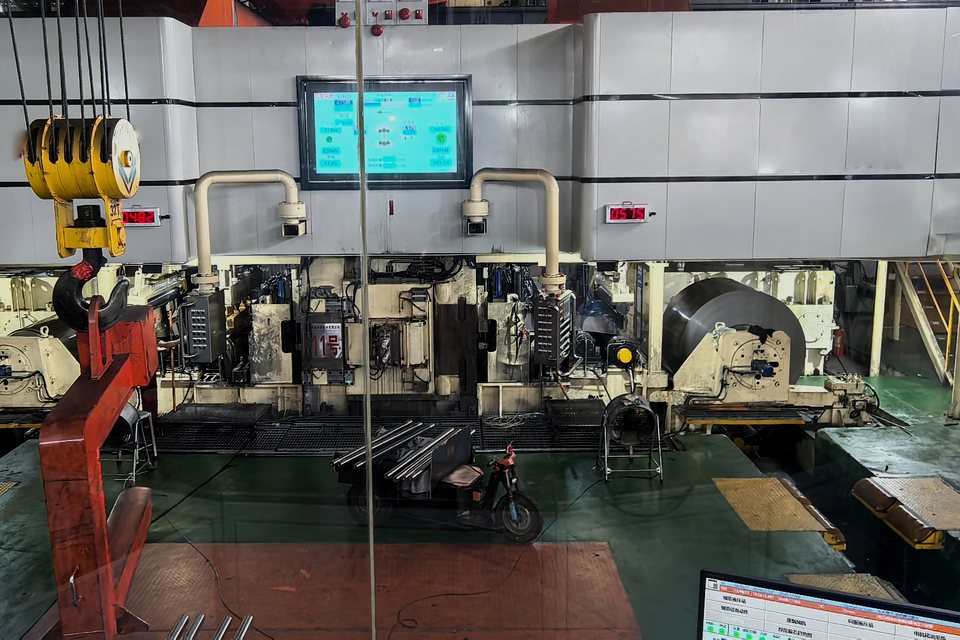
Product Overview
JINYE tension levelers are used to improve wave shape, coil set, residual stress, and strip flatness in continuous production line and finishing line projects. They can be arranged before or after annealing, strip cleaning, or independent finishing sections.
The equipment is customized according to material yield strength, thickness range, elongation target, incoming flatness, production speed, and upstream/downstream interfaces.
Parameter Classification
| Double-bending single-leveling | Compact tension leveling layout for continuous line flatness correction where the process needs controlled bending and a simpler leveling section. |
|---|---|
| Double-bending double-leveling | Higher correction capacity for stricter flatness targets, more demanding incoming wave shape, or process routes requiring stronger elongation stability. |
| 23-roll tension leveler | Multi-roll layout for precision strip shape correction and residual-stress improvement in high-surface-grade or high-flatness finishing routes. |
| Strip width classes | 350 / 450 / 550 / 650 / 750 / 850 / 950 / 1050 / 1150 / 1450 / 1780 mm reference classes |
| Speed classes | Approx. 500 m/min for 350-450 mm classes; 600 m/min for 550-750 mm classes; 800 m/min for 850-1780 mm classes |
| Control focus | Tension stability, elongation control, roll gap adjustment, speed synchronization, and flatness feedback |
| Integration | Can work with cold rolling mills, strip cleaning lines, annealing lines, or independent finishing lines inside the turnkey plant route |
Width and Speed Logic
The supplied parameter sheet groups tension levelers by width and reference speed: 350-450 mm classes at about 500 m/min, 550-750 mm classes at about 600 m/min, and 850-1780 mm classes at about 800 m/min. The final layout depends on yield strength, thickness range, elongation target, and required outgoing flatness.
Typical Applications
- Flatness improvement for high-surface-grade metal strip before downstream finishing.
- Strip leveling after annealing or before cleaning and downstream finishing.
- Continuous lines requiring stable elongation, tension control, and speed synchronization.
Project Data Needed
Tension leveler selection should confirm material yield strength, thickness range, strip width, target elongation, incoming shape, required outgoing flatness, line speed, and upstream/downstream interface. Width class alone is not enough for reliable configuration.